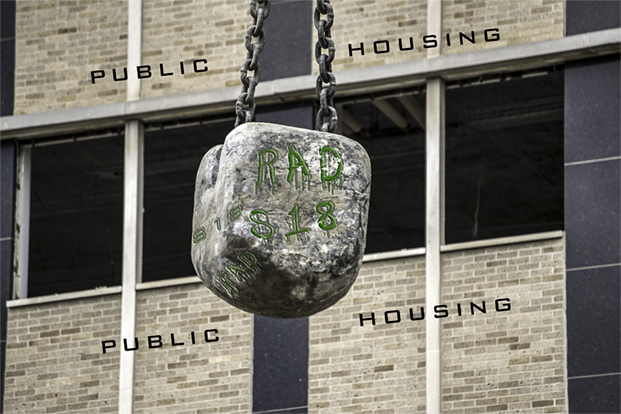
NYCHA to evict family member, not on the lease, is another What Would You Do? article. This article started out as a simple two-part story but as you will see it led to much more.
Double Talk
As defined by the Merriam Webster Dictionary “Double Talk” is a language that appears to be earnest and meaningful but in fact, is a mixture of sense and nonsense. This sums up Mayor DeBlasio’s proclamation of providing “affordable” homes for New Yorkers. Especially when it comes to NYCHA housing. Take the following case where NYCHA is bending over backward to evict a tenant for monetary gain. In other words, NYCHA wants to rent the apartment at “market rates”. Market rates are not what you would call affordable.
NYCHA’S Other Dirty Little Secret
NYCHA has been in the news a lot lately. First for lack of heat in apartments, then for covering up lead exposure in its apartments. But did you know that they made the news for something just as bad but less talked about? It concerns the eviction of family members who are not on the lease when the leaseholder dies. While it is true that NYCHA has the right to evict those that are not on the lease. There are times when NYVCHA needs to show compassion to its tenants. In the case of family caregivers, NYCHA needs to reconsider its position.
The Family Member
Are you taking care of a family member? Do you live in their apartment but are not on the lease? If so, then this story is for you. It is about a friend’s effort to stay in his NYCHA apartment. Actually, the apartment was his mother’s until she passed. That’s when things got crazy. Let me lay out a few things for you. First the situation you are in.
The Situation
You are living with a family member in their apartment. You are not on the lease. The family member becomes sick and you take on the duties of caring for them. This lasts for quite sometime before that person passes away. You continue to live in the apartment and approach NYCHA requesting to stay in the apartment. NYCHA moves to evict you.
The question I asked my friend was why didn’t he have his mother put him on the lease?
Bad Advice
The leaseholder got bad advice from friends. They advised her not to place her sons on the lease. Al and Mac–as we call them–honored their mother’s wishes. They did not push their mom to be added to the lease.
Tragedy Strikes
Tragedy would strike this family three times. Their mother’s longtime companion would die after surgery. Al would pass soon after from a heart attack. Mac’s mother became ill. He became her caregiver. He did this while dealing with his own major medical issues. After his mother died Mac continued to pay the rent never missing a payment.
Using money from his disability check Mac maintained the apartment. NYCHA has not made repairs in the apartment for years. Maintenance, as has been reported in the media, was and still is non-existent.
There are no complaints against him. For more than 15 years Mac along with his mother, her companion, and his brother called this apartment home.
NYCHA moves to evict a family member
Upon learning of the passing of the mother NYCHA proceeded with eviction proceedings. The official excuse, Mac is not on the lease. His mom through advice from friends did not place him on the lease. Her reason, she did not want the rent to go up.
On the face of things, this seems reasonable but let’s look at this closer. Had the mother placed them on the lease NYCHA would have had to find a larger apartment. Remember there are four adults in a one-bedroom apartment. A larger place means more space. It would mean more rent but the sons would have been able to cover it. Because of bad advice and fear of losing her apartment Mac’s mom did nothing. That said let’s look at NYCHA’s reason for eviction.
NYCHA’s True Reason For Eviction
The true reason is as simple as the old adage, “Follow the money”. When asked how much his rent is Mac told me this his one-bedroom is 253.00 per month. Based on Mac’s income and expenses this is the affordable rent amount for him. If NYCHA prevails they will evict Mac who has nowhere to go. NYCHA will then raise the rent to market level for the next tenant. This is not what you or I would call providing affordable apartments for all.
1-Bedroom Rental
A search for 1-bedroom apartments in East New York returned no results on Trulia.com. And I never use Craig’s list and neither should you. But that’s my opinion.
Therefore, I needed to rely on the asking rental amounts I came across 2 years ago. At that time one-bedroom apartments were approaching the one-thousand-dollar level. So it is not a stretch to consider that a one-bedroom in East New York goes for 1200.00 on the low end. NYCHA stands to make substantial gains if it can evict all tenants paying below-market-rate rents for apartments. But isn’t that something that the mayor is against?
Does not Mayor DeBlasio oppose landlords who remove tenants just to raise rents?
Seek Advice Again
Faced with possible eviction Mac sought out advice and ran with it. He and his son began working diligently to hold onto the apartment. They searched online for information to prepare for the court battles.
They did not approach the city for a lawyer. Not that it would have mattered. The much-touted free lawyers for all tenants is not fully rolled out. See Click here to read the article and check here to see if the Right To Council NYC is in your area. As of the first publishing of this article, it is not available in East New York.
Mac decided to wait and see what NYCHA would do. Not something I would recommend because I don’t trust the other side to do the right thing.
Step by Step
The management office was sympathetic. They gave him the papers he needed to file. He was briefed on the procedures NYCHA would pursue. Paperwork was filed with NYCHA as instructed. The rent continued to be paid rent on time. Mac kept records of every payment. If NYCHA was late requesting the rent he went to them and paid it.
Arbitration, not Tenant-Landlord Court
Mac submitted every document requested, including medical records. His medical history became a major factor. He had a heart attack bringing documents to the court.
The people at the management office spoke up on his behalf. But it was the NYCHA lawyer that was a problem. He seemed determined to evict Mac no matter what. And then there is the problem that this was not a case in Tenant Landlord Court. NYCHA arranged arbitration without Mac’s knowledge, but more on that later.
The Decision
The arbiter denied the petition but recommended that NYCHA not put Mac out. This was based on his health. Mac was advised to continue to pay the rent.
Happy Ending, Not So Fast
At first, it seemed that NYCHA was abiding by the recommendation. But months later NYCHA left a notice ordering Mac to vacate the apartment. If he did not he would be forcibly removed from the apartment.
Mac contacted me and read me the notice; there were glaring violations in it.
The notice was delivered five days into the month but demanded that he vacate by the end of the month. In New York, the law says you must give a 30-day notice of eviction. After which the case goes to Tenant Landlord court. See “True Crimes in Real Estate: It’s my house. I can do whatever I want.” for more details
The notice was in the form of a lawyer letter on NYCHA stationary. The notice did not state that the eviction had been placed in the Tenant Landlord Court.
And then there is the matter of the rent. Mac had paid the rent for that month on time. NYCHA took the payment and provided a receipt. So if NYCHA wanted to evict Mac they needed to attempt eviction the following month and not take the rent. The following month NYCHA ACCEPTED THAT RENT TOO.
Deja Vu?
I’ve written about this exact thing before.
See What Would You Do? A New Series. Read The Unfair Eviction Part 1 on what happens when don’t know your rights. And someone does this to you. Back to our story.
Legal Aid
During the month that Mac received this notice, he found a Legal Aid lawyer. That lawyer advised Mac on how to proceed. This worked for several months until NYCHA began another eviction, this time following the rules.
But the stress of fighting NYCHA would again take its toll on Mac. He landed in the hospital where he underwent another heart surgery. Since the beginning of his battle against NYCHA Mac has endured multiple heart surgeries.
When Legal Aid Fails You
Days before his latest court date in front of a judge, not an arbiter, the Legal Aid lawyer quit the case. She stated that she was now working on behalf of NYCHA. No replacement was assigned. This meant that Mac went to court without equal representation. NYCHA had their lawyer; Mac had himself and his son.
Note: In a situation like this you have the right to request a lawyer. This is because the “field is not even”. Unless you are versed in the law you do not stand a chance against a lawyer.
The judge adjourned the case after hearing both sides. He has requested Mac to supply information supporting his reasons to remain in the apartment. At the next hearing date–Feb 2019–Mac got another chance to fight for the apartment. The results of this I will reveal in the next part of this report.
Clarifications
In this article, I stated that in his first hearing Mac went before an arbiter, not a judge. There is a distinct difference between the two. Mac kept referring to the arbiter as a judge and only after I asked him to describe the setting of the hearing did I realize what had happened. The case never went to Tenant Landlord Court, instead, NYCHA pulled a fast one and set up an arbitration. This was done without Mac’s knowledge.
Take note: You want your case heard in front of a judge in Tenant Landlord Court. Mac’s hearing was at a location NYCHA designated. NYCHA had its lawyer present; Mac did not have a lawyer. The arbiter did not inform Mac that he was entitled to equal representation.
New York Daily News Article
There is precedence to show that NYCHA can reverse itself in such matters. The following is an article from the Daily News on a case much like the tenant in this article.
Summary
A daughter moves in with her mother to take care of her. This goes on until the mother passes. During that time of caring the daughter files the necessary papers with NYCHA to have herself added to the lease. There is confusion about the proper paperwork and it is re-filed. NYCHA loses the paperwork and tries to evict the tenant.
In this story there is a happy ending nonetheless the misery NYCHA put this person through was unnecessary.
PressReader – New York Daily News: 2018-01-07 – EVICTION REPRIEVE
Final Word
There are lots of other people in Mac’s development going through the same thing. The odds are they will not remain in their apartments. Despite NYCHA’s growing list of problems, it is still determined to put people on the street. It seems bad press does not deter the NYCHA eviction machine. Make no mistake if you are in this situation and do not take steps to secure the apartment NYCHA will move to evict you. But who knows, you could do all the right things and still face eviction. This is because NYCHA wants your apartment so it can raise the rent on it or so I thought.
To be continued…here
Disclaimer: I am not a lawyer and nothing stated here is legal advice. This article applies to the five boroughs of New York. All information deemed accurate but not guaranteed. Always check the real estate laws in your part of the country.
Comments, Questions, Suggestions?
Was this article helpful? Did you learn anything new? I would like to hear your comments on this and any other article on this site. Take a moment, leave a comment or suggestion. Let’s start a conversation today.