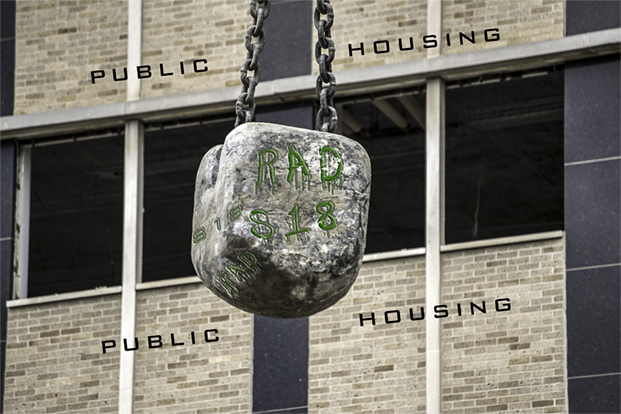
Can the destruction of public housing by RAD it be stopped? That is a great question. The RAD wrecking ball is a public housing killing machine. Its primary mission is to destroy public housing and replace it with privatized housing. The result is the removal of all public housing. Every place RAD has gone, the destruction of public housing has followed. Private ownership took over.
These new owners are supposed to follow the rules of the program. But since there is no oversight or accountability, the rules mean nothing.
So now comes the question: What do you do when owners don’t follow the rules? Like others, I was stumped for an answer. So I looked online to see what other states have done. I found some interesting items. One of which was how and why RAD came into existence.
The Destruction Of Public Housing By Federal Neglect Creates RAD
The Rental Assistance Demonstration program did not have to be. The failure in public housing traces back to a lack of appropriated funds for public housing. The federal government, specifically Congress, neglected public housing for years. The attitude and prejudices of past congresses led to a lack of funding. This lack of funds led to the poor condition of public housing. Public housing complexes were left to decay until the only answer was RAD.
Shelter Force released an excellent article on this and more. To learn more about the failure of public housing and RAD exists read The Promise and Peril of HUD’s RAD Program.
Learning the Rules Changing The Rules of The Game
Digging deeper into the Rental Assistance Demonstration program makes one thing clear. This is a complicated mess of a program. Stopping it appears doubtful. So what do you do? You learn the rules of this game. Then become the best at the game and finally change whatever rules you can change.
A search of the internet reveals how other states affected by RAD took steps to deal with it. Defend Glendale And Public Housing Coalition is active in Minneapolis. Reading about their efforts What you need to know about The RAD Program and Section 18 is a blueprint to creating a strategy.
The New York Effort
In 2018, New York became one of those states. Representatives from different developments form a roundtable panel. They created two important items. The RAD Resident Handbook and Principals For The Rental Assistance Demonstration. This was New York’s effort to have a say in the implementation of RAD. But it should not be the last.
Some members of the roundtable came from:
- Ralph J. Rangel Houses Tenant Association, Manhattan
- Ocean Bay (Bayside) Tenant Association, Queens
- Woodside Houses Tenant Association, Queens,
- Wyckoff Gardens, Brooklyn,
- Fred Samuels Houses Tenant Association
The East New York Coalition
As you can see, not every development was represented. In 2018, it was not necessary. But that has changed. Developments today need to band together and form committees.
Developments in close proximity to each other need to form a coalition. For example, in East New York, Linden and Boulevard houses border each other. They have a common interest: protecting their tenants’ rights. A coalition is a way to do that.
Changing The Rules: PRINCIPLES FOR THE RENTAL ASSISTANCE DEMONSTRATION
As previously stated, in 2018, New York created principals that affected RAD. These principles lay out guidelines concerning the implementation of RAD. This is a clear example of learning the rules of the game, then changing the rules for the better. At least for the most part.
Excerpt: “The RAD Principles are intended as supplemental to rights and protections already provided by federal and state statute, U.S. Department of Housing and Urban Development (HUD) regulations, and HUD notices. The HUD notice related to resident protections is included as an appendix.”
Some items in the guidelines are presented here in an abbreviated form. Read the full text here
The principles are broken down into sections. For example the following concern “Residents”
Residents
- Notice of RAD Candidacy
Residents and Resident Associations (RAs) will have notice that their development is under NYCHA consideration for RAD conversion. - Resident Education
A RAD handbook shall be distributed to all affected residents, providing comprehensive information about RAD conversion, including how RAD will differ from public housing and the potential impacts for residents and the community. - Right to Organize
Residents have the right to form a resident organization (RO) to represent all residents in the development, which the developer/property manager (PM) must recognize. - Resident Participation Funding
The RO will decide on how to use the RO portion of Resident Participation Funds within the uses permitted under RAD, including discretion over engaging community organizations for technical assistance and education. - Communications Among ROs
In order to promote communication among ROs once a number of RAD conversions take place, NYCHA will provide ROs with contact information for other RAD property managers to enable organizations to communicate. - Grievances and Lease Terminations
NYCHA will develop a set of procedures for resident grievances and lease termination proceedings that will take effect upon conversion.
The handbook contains volumes of information on the program. It is easy to read and understand. The Resident Handbook is a great starting point in learning about RAD. The section about the risk of the program is a must-read.
As for Section 18, this article by the Defend Glendale and Public Housing Coalition is an excellent starting point.
Note: When reading this handbook, it is important to read the words as they are and not as you interpret them to be.
Example: “After conversion, anyone living with you, who is not on the lease, may be required to leave.”
It does not say will have to leave… There is a huge difference between “will and may be”. “May be” allows you to fight the eviction. “Will” means they have made up their minds about what you must do.
Know Your Rights
Without oversight and accountability, the tenant’s rights are in danger. I suggest anyone affected by RAD read these two documents thoroughly. Knowing your rights, learn how to fight back. And when necessary, pursue legal action.
In other words, “Do Your Due Diligence.”
Why is this important?
Consider the following incident.
In one meeting, tenants were told that NYCHA would pursue evictions if there were too many people in an apartment. But the handbook says otherwise.
From Handbook: “If you are living in an over or under-occupied apartment, you may be moved to a right-sized unit if an appropriately sized apartment becomes available in the same development.”
Nowhere does it say you will be evicted. Evictions cannot be based solely on the number of people in an apartment. In the case of the family size, it is against Fair Housing laws.
Problems With RAD As Reported By The GAO
Another way of fighting back is to know what the government says about the program. A review of the program in 2018 by the Government Accounting Office pointed out the problems with the program.
Excerpt: On March 22, 2018, the Government Accountability Office (GAO) released a 72-page report evaluating the program. The report, Rental Assistance Demonstration: HUD Needs to Take Action to Improve Metrics and Ongoing Oversight, mirrors many of our concerns and experiences with HUD’s implementation and oversight that we expressed to Secretary Carson last year.
Judging by the continuing problems with RAD, little if anything, has changed. Keep in mind that the present administration removed all oversight and accountability. While at the same time expanding the reach of RAD and Section 18. The result has been an overall reduction in public and affordable housing.
Residents Removed And Not Allowed To Return
In New York
Recently told to me: Tenants removed from their apartments during renovations were denied access back into their renovated apartment. This is a violation of the program. What should you do?
In Virginia
Tenants in Hopewell, Virginia, knew what to do. The tenants filed a lawsuit for this and other violations. After an investigation by HUD but the complainants won their suit.
Excerpt: Their complaint sparked a HUD investigation that resulted in a settlement agreement with $225,000 in monetary compensation for the five named complainants and an additional $112,300 for the other 25 affected residents,…
Heed The Signs
There is an old saying that says, “Heed the signs”. The articles in this series have given you enough information to see the truth behind the lie.
Read Recapping RAD Section 18 And The Attack On Public Housing to remind yourself of what’s going on. And believe that it will happen here. There is no reason that developers would not use proven underhanded tactics here in New York. One last thing…
Organize and Raise Your Voice
Meetings about RAD take place in the projects. Few people outside the projects hear about these meetings. The program does not require notice to anyone not affected by the program. But in reality, we are all affected. The destruction of public housing affects the surrounding area. That includes the gentrification that the developer and, yes, the city may have in mind.
So tell your friends, spread the word, and let everyone know about these meetings. The destruction of public housing by RAD may not be able to be stopped, but its effects can be controlled.
Disclaimer:
I am not a lawyer, and nothing stated here is legal advice. This article applies to the five boroughs of New York. All information is deemed accurate but not guaranteed. Always check the real estate laws in your part of the country.
Comments, Questions, Suggestions?
Was this article helpful? Did you learn anything new? I would like to hear your comments on this and any other article on this site. Take a moment, leave a comment or suggestion. Let’s start a conversation today.
Share This Post